By Shakhawat Ullah
14 Min Read
Agentic AI for Sales: How AI Agents Are Changing eCommerce
Your eCommerce store has traffic. Products are live. Maybe you even have a chatbot.
But shoppers still leave without buying.
Someone wants to know which product fits their needs. Someone asks if an item is in stock. Someone hesitates at checkout because they are not sure the product is worth it.
A regular chatbot can answer a few basic questions, but it cannot guide the shopper, recommend the right product, or move the sale forward.
That is where agentic AI for sales is different.
An AI chatbot talks. An AI sales agent acts. It can understand what a shopper wants, search your catalog, check live inventory, recommend products, apply discounts, and even add items to the cart.
For eCommerce stores, that changes the role of chat from support tool to sales channel.
In this guide, you’ll learn:
- What agentic AI for sales actually does, and how it differs from a regular AI chatbot
- Why AI agents in sales drive real revenue, backed by hard numbers
- How AI for eCommerce changes the way shoppers buy
- How to build an AI sales agent for your WooCommerce store, step by step
- Which best WooCommerce plugins are worth your time for AI sales
Let’s get started.
What Does A Sales Agent Do?
Agentic AI for sales is a type of AI that takes real actions. It does not just answer questions. It makes decisions, runs tasks, and completes goals with little to no human input.
Think about a regular AI chatbot. You type a question, and it pulls an answer from a script or a knowledge base. That is generative AI at work.
It talks. It writes. But it does not act on its own.
An AI agent works differently. Give it a goal, like helping a shopper find the right product, and it figures out every step on its own. It searches your catalog, checks stock, reads the shopper’s intent, and recommends the best match.
Here is a concrete example. A shopper types “I need a gift for my mom, she loves cooking.”
An agentic AI reads that, searches your product catalog for cooking-related products, filters results by popularity or price, and surfaces three strong options. It can even follow up with “What is your budget?” That is not a scripted bot. That is a sales agent.
That gap between talking and doing is what makes agentic AI a category of its own.
According to McKinsey, 78% of organizations are using AI in some capacity, with 85% having adopted it in at least one business process. But most of those deployments are still generative AI.
The shift to agentic AI is the next trend that is happening right now.
Here is a simple way to picture it. A vending machine gives you exactly what you select. A personal chef asks what you are in the mood for, checks what is available, and cooks accordingly.
Generative AI is the vending machine. Agentic AI is the personal chef.
For eCommerce, that distinction matters a lot. Shoppers do not always know what they want. They browse, get stuck, and leave before buying.
An AI shopping assistant that reads intent and guides a shopper to a purchase does something a standard chatbot never could. That is the new foundation of AI for eCommerce.
How AI Agents in Sales Compare to Regular Chatbots
AI Sales Agents and regular chatbots are not the same tool. They share a chat interface. That is about where the similarity ends.
A regular AI chatbot is reactive. It waits for a question, finds a pre-written answer, and sends it back. Think of it like a search bar with a friendlier face.
An AI sales agent is proactive. It tracks context across the whole conversation, connects to your live store data, and takes real actions. It can search your catalog, check inventory, or apply a coupon code.
Here is the comparison in plain terms:
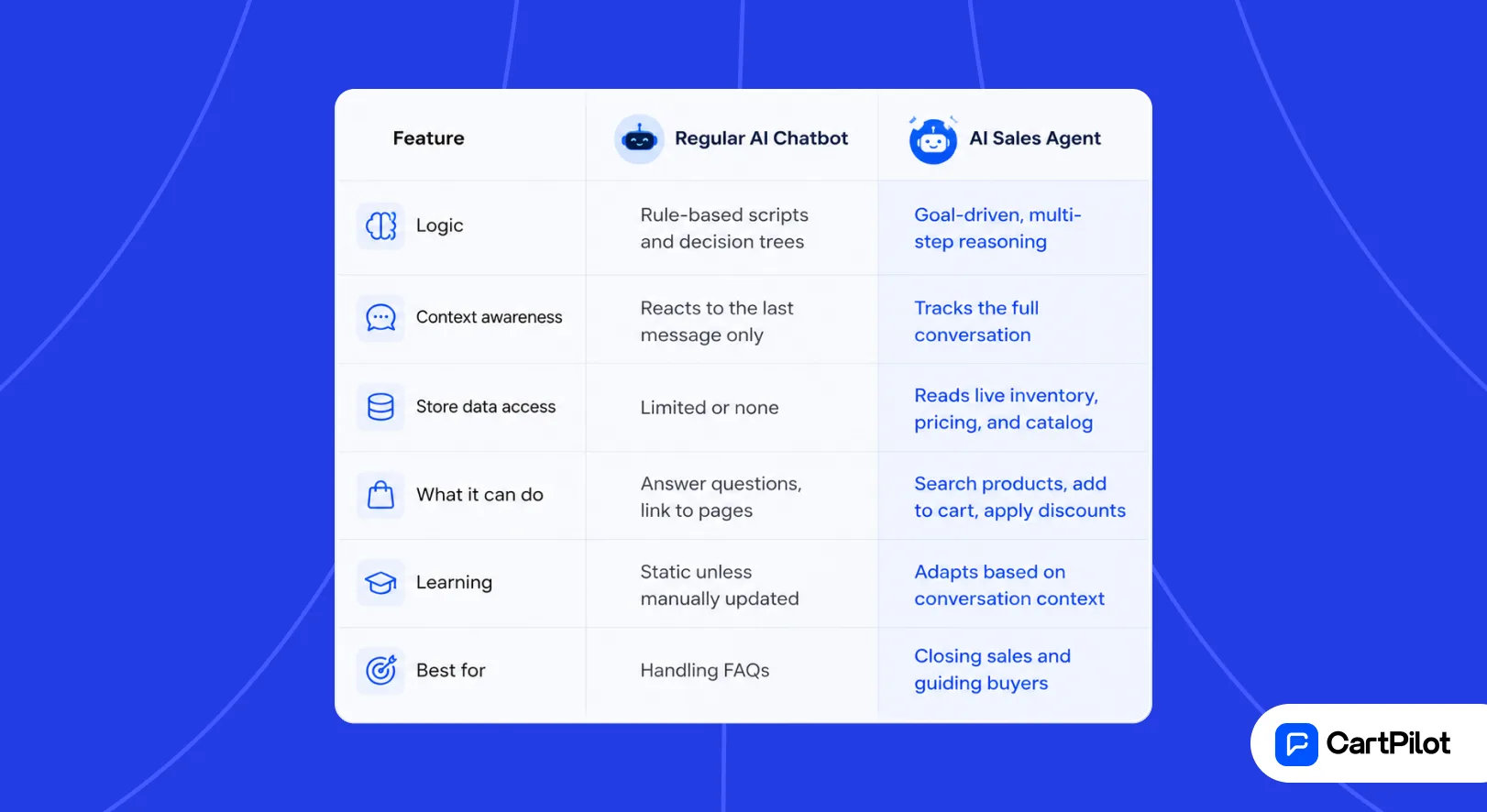
This difference is not just technical. It changes your conversion rate. A chatbot that links a hesitant shopper to your returns policy does not move the needle on revenue. An AI sales agent that helps that same shopper pick the right product, answers their last objection, and adds the item to their cart does something a chatbot cannot.
If you want to go deeper on how AI sales agents work in practice, read our guide: What Is an AI Sales Agent? A Practical Guide for eCommerce Stores.
Look at What the Data Says About AI for eCommerce
The ROI numbers behind agentic AI are not hypothetical. Real companies have deployed AI agents and published their results. Let’s start with the most-cited example.
Klarna deployed an AI agent across its customer service operations. By Q3 2025, that agent was handling a workload equal to 853 full-time employees. The company reported $60 million in annual savings from that single deployment.
The speed gains were striking on their own. Before the agent, average resolution time was 11 minutes. After deployment, it dropped to under 2 minutes.
That is not what a chatbot does. Chatbots answer FAQs. An AI agent resolves issues and keeps the conversation moving forward.
Klarna later brought human agents back for complex and emotionally charged conversations. The lesson: AI handles volume well, but humans still handle nuance better in high-stakes moments.
Here is what the broader data shows:
| Metric | Statistics |
|---|---|
| Average ROI on agentic AI deployments | 171% |
| U.S. enterprise average ROI | 192% |
| Klarna annual savings | $60 million |
| FTE workload handled by Klarna AI | 853 employees |
| Avg. resolution time before AI | 11 minutes |
| Avg. resolution time after AI | Under 2 minutes |
| JPMorgan lawyer-hours saved annually | 360,000 hours |
| Agentic vs. traditional automation ROI gap | 3x higher |
For eCommerce, faster resolution means fewer abandoned carts and more completed purchases.
An online shopper who gets a quick, relevant answer from an AI shopping assistant is far more likely to complete the purchase. A shopper who hits a scripted dead end costs you the sale and potentially the customer.
The Baymard Institute puts average cart abandonment at 70%. Not all of that comes from poor support. But a meaningful portion of those shoppers left because no one answered their question in time.
An AI agent changes that math. For store owners, this is becoming one of the biggest conversion advantages available.
Put AI Shopping Assistants to Work in Your Store
AI shopping assistants do their best work right in the middle of the buying journey, not after a shopper has already made up their mind. That is when questions surface, hesitation sets in, and carts get abandoned.
Think about the three moments where shoppers typically get stuck: product discovery (“I don't know which one to buy“), pre-purchase doubts (“Is this the right size?“), and cart hesitation (“Should I really spend this much?“). These are the exact moments where a scripted AI chatbot falls short and an AI shopping assistant earns its keep.
Product discovery is where AI agents create the most immediate value. A shopper who types “I need running shoes for trail hiking, budget under $100” and gets three specific results from your actual catalog is a shopper who stays on your site. They do not Google the question and end up on a competitor’s page.
Here is how AI shopping assistants handle real WooCommerce scenarios:
| Shopping Scenario | What a Chatbot Does | What an AI Agent Does |
|---|---|---|
| “Which laptop bag fits a 15-inch laptop?” | Links to the product category | Filters catalog by size, returns top matches |
| “Is this coat available in blue, size M?” | Says “check the product page” | Checks live inventory, confirms or offers alternatives |
| “I’m not sure this is worth the price” | Links to the reviews page | Highlights features, surfaces social proof, applies available discounts |
| “Something like this but cheaper?” | Cannot handle the request | Searches for similar products in a lower price range |
| “Add the red one to my cart” | Cannot perform this action | Adds the specific variant to the cart instantly |
That last row matters most. Cart manipulation is where agentic AI leaves chatbots completely behind. When an AI agent can add items, change quantities, or apply a promo code from inside the chat window, friction drops and conversion rates go up.
One mistake many stores make is treating their AI agent like a support tool instead of a sales tool. They point it at help content and call it done. That wastes most of the agent’s capability.
The stores that get the most from AI shopping assistants treat the agent like a junior salesperson, not a knowledge base. They give it access to real product data. They train it on what shoppers actually ask, and they measure it on revenue, not just response rate.
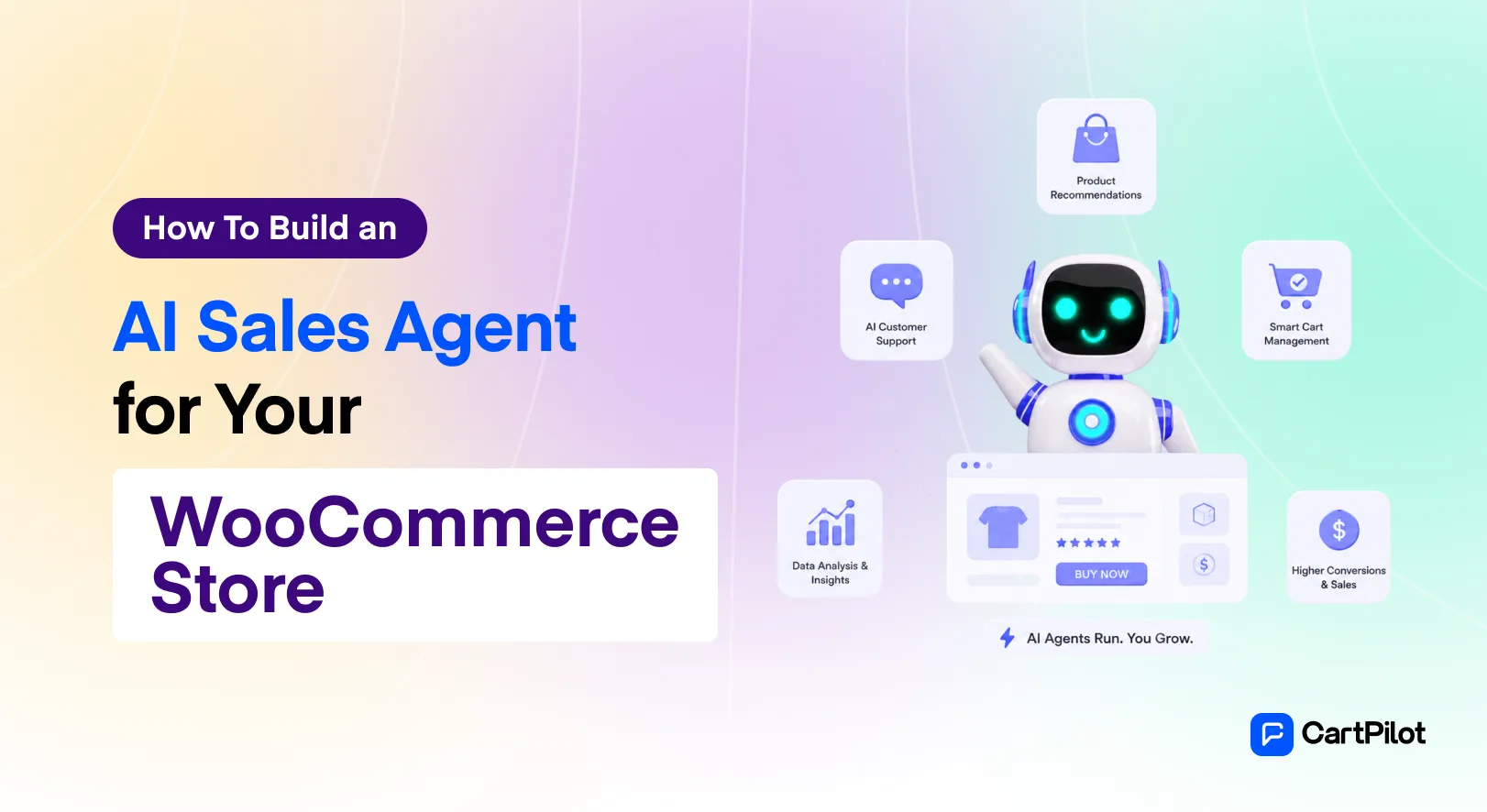
How To Build an AI Sales Agent for Your WooCommerce Store
Learning how to build an AI sales agent for WooCommerce is more straightforward than most store owners expect. You do not need a developer or a months-long setup.
Here is a practical path that works.
Step 1: Define What You Want the Agent to Do
Do not start with the technology. Start with the goal: should the agent help shoppers find products, handle pre-purchase objections, or add items to the cart?
Pick one primary job first, because agents that try to do everything often do nothing well.
Step 2: Connect It to Your Live Store Data
This is the step most stores skip. Without access to real inventory, live pricing, and product variants, your AI agent is guessing.
Connect it to your WooCommerce catalog from day one, so the agent knows what you sell, what is in stock, and what the current prices are.
Step 3: Set a Clear Conversation Objective
Every agent needs a primary goal for each conversation. For most WooCommerce stores, that means one of three things: help the shopper find the right product, answer a pre-purchase question, or move an item into the cart.
Keep the scope tight. A focused agent converts better than a sprawling one.
Step 4: Test Before You Go Live
Run the agent through fifty real shopper questions before launching. Check where it gets stuck, where it gives wrong answers, and where it fails to act when it should.
Fix those gaps before your customers see them.
Step 5: Track Revenue from Chat, Not Just Conversations
Watch three numbers: conversations started, cart additions from the agent, and completed purchases from chat sessions. If shoppers are chatting but not buying, the conversation flow needs adjustment.
The speed of return depends almost entirely on how clean your data is and how clear your agent’s goal is.
A tool like CartPilot is built specifically for this workflow. It connects directly to your WooCommerce catalog, handles cart actions from the chat window, and acts as a full AI sales agent without requiring custom development. Worth a look if you want to skip the setup complexity.
Choose the Best WooCommerce Plugins for AI Sales
Not all WooCommerce plugins that claim AI features are worth your time. Most are AI chatbots with a polished interface.
Here is what actually separates a genuine AI sales agent from a glorified FAQ bot.
When evaluating the best WooCommerce plugins for AI sales, check for these five things.
1. Live catalog access: Can the plugin read your current product inventory in real time? A plugin working from a cached snapshot will give shoppers wrong availability information. That is worse than no AI at all.
2. Cart manipulation: Can it add items, change quantities, or apply coupon codes from inside the chat window? This is the clearest dividing line between an AI chatbot and a true AI sales agent. If the plugin cannot touch the cart, it cannot close sales.
3. Conversation memory: Does it remember context across the full conversation? A plugin that forgets what the shopper said two messages ago is useless for complex, multi-step buying decisions.
4. WooCommerce-native integration: Does it connect directly to WooCommerce or does it need third-party middleware? Native integrations set up faster, break less often, and stay in sync with your store data automatically.
5. Revenue attribution: Can you track which sales came from the AI agent? Without attribution, you cannot prove ROI, adjust your approach, or justify the cost.
Most AI chatbot plugins on the market today tick one or two of these boxes. Fewer tick all five.
One common trap is picking a plugin because setup looks easy. Generic AI chatbot builders are fine for customer support. They are not built for sales. They lack catalog access, they cannot touch the cart, and they track conversations instead of revenue.
Starting with the wrong tool costs more time than starting with the right one.
Frequently Asked Questions
What is agentic AI for sales?
Agentic AI for sales is a type of AI that takes real actions inside your store, not just answers questions. It can search your product catalog, check live inventory, recommend products, and add items to a shopper’s cart without human input. Unlike a regular chatbot, it has a goal, reasons through steps, and completes tasks on its own.
How is an AI sales agent different from a regular chatbot?
A chatbot follows a script. Ask it something off-script and it fails. An AI sales agent understands the intent behind a question and works out the steps to help. It can access your live product data, touch the cart, and guide a shopper through a complete purchase, which is something a rule-based chatbot simply cannot do.
How do I build an AI sales agent for my WooCommerce store?
Start with a clear goal: pick one job for the agent, such as helping shoppers find products, handling objections, or adding items to the cart. Then connect it to your live WooCommerce catalog. Test it with real shopper questions before going live, and track revenue from chat sessions so you can measure what is actually working.
What are the best WooCommerce plugins for AI sales agents?
The best WooCommerce plugins for AI sales connect directly to your product catalog, can manipulate the cart from inside the chat window, and track which conversations lead to purchases. CartPilot is built specifically for this use case. Avoid generic chatbot builders that lack direct WooCommerce integration or cart access.
How much does it cost to add an AI sales agent to WooCommerce?
Costs vary by tool. Generic chatbot builders often start free but lack real AI sales capabilities. Dedicated AI sales agent platforms for WooCommerce typically use subscription or credit-based pricing. CartPilot uses a credit-based model. A well-configured AI sales agent typically pays for itself quickly once it starts converting conversations into orders.
Can an AI agent actually increase eCommerce sales?
Yes, when set up correctly. Klarna’s AI agent cut average resolution time from 11 minutes to under 2 minutes and saved $60 million in a year, according to Klarna’s Q3 2025 figures. For eCommerce stores, the gains come from faster answers to pre-purchase questions, fewer abandoned carts, and higher average order values through relevant product recommendations.
What data does an AI shopping assistant need to function properly?
At minimum, it needs access to your live product catalog, current inventory levels, pricing, and product variants. Without this data, the agent cannot give accurate recommendations or confirm availability. The more complete your product data, the more useful the agent becomes for shoppers making buying decisions.
Is agentic AI for eCommerce right for small WooCommerce stores?
Yes. Small stores often benefit most because they cannot staff a full-time sales support team. An AI agent that handles product questions and guides shoppers to purchase does the work of multiple staff members, around the clock. The key is picking a tool with a simple setup that does not require a developer to maintain.
Start Treating Your Chat Window Like a Sales Channel
The stores winning with AI are not the ones with the biggest budgets. They are the ones that gave their AI agent a real job, connected it to real data, and measured it on real revenue.
Agentic AI for sales is not complicated. A chatbot talks. An AI agent sells. The technology is ready. The question is whether your store is using it.
CartPilot gives your WooCommerce store a real AI sales agent. One that reads your catalog, guides shoppers, and closes sales from the chat window. If you want to stop losing sales to unanswered questions, try CartPilot and see what an AI sales agent can do.
Category:
Tags: