By Shakhawat Ullah
14 Min Read
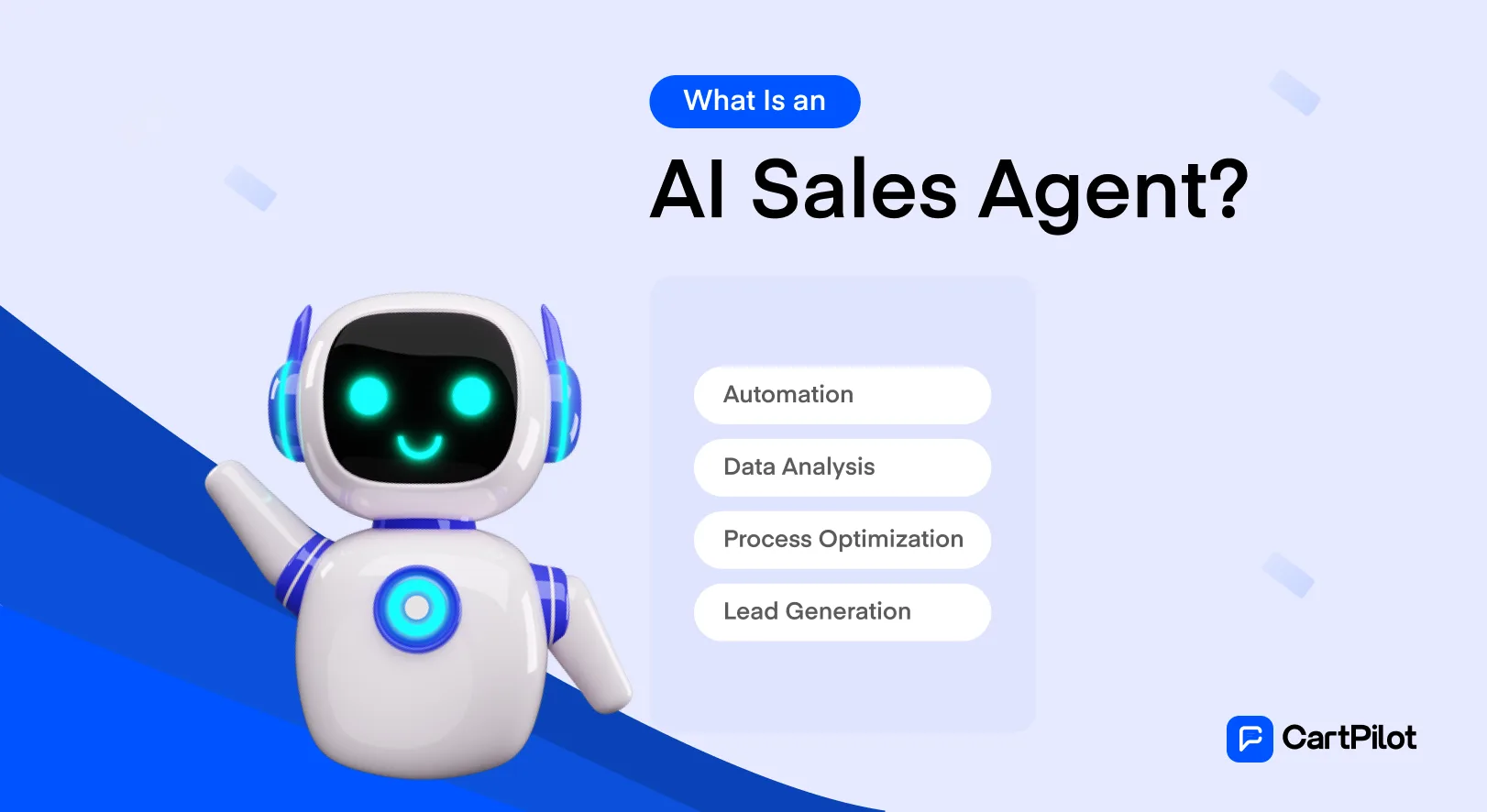
What Is an AI Sales Agent and How Can It Help eCommerce Stores Sell More?
Running an eCommerce business in 2026 is difficult. In the last five years, customer acquisition costs rose by over 60%. That’s a lot of money just to get shoppers through the door.
And once they arrive? Most stores hand them a search bar and hope for the best.
An AI sales agent changes all of that.
It doesn’t wait for shoppers to figure things out. It searches your catalog, answers questions, compares products, and adds items to the cart. All through a simple chat box.
In this guide, you’ll learn:
- What an AI sales agent is and how it works
- How it differs from a traditional chatbot, and why that gap is bigger than you think
- What it can do for your store, backed by real data
- How to pick the right tool
- How to get started, step by step
Let’s get into it.
Understand What an AI Sales Agent Really Does
In simpler terms, an AI Sales Agent is a smart salesperson in your store. It connects to your store’s catalog. It reads what customers type in plain language. Then it takes action.
It searches products, compares options, and adds items to the cart. All done without any human oversight.
Most chatbots help shoppers find answers. An AI sales agent helps them buy. That’s a big difference.
Three things make it work:
- Natural language understanding: it reads full sentences and questions, not just keywords
- Retrieval-Augmented Generation (RAG): it pulls live data from your catalog, inventory, and store policies in real time
- Tool-calling: it executes tasks like updating the cart, looking up orders, and comparing products side by side
The data it works from matters a lot. It doesn’t rely on generic product descriptions. It syncs with your live catalog. That means current prices, variants, stock levels, and categories.
It also knows your store’s rules. Say a shopper asks about a blue item under $80 that needs to arrive by Friday. The agent checks your real inventory and shipping estimates. It doesn’t guess.
An AI agent doesn’t just respond. It reads a situation, makes a decision, and acts. That’s what sets a real AI sales agent apart from a chatbot with nice copy.
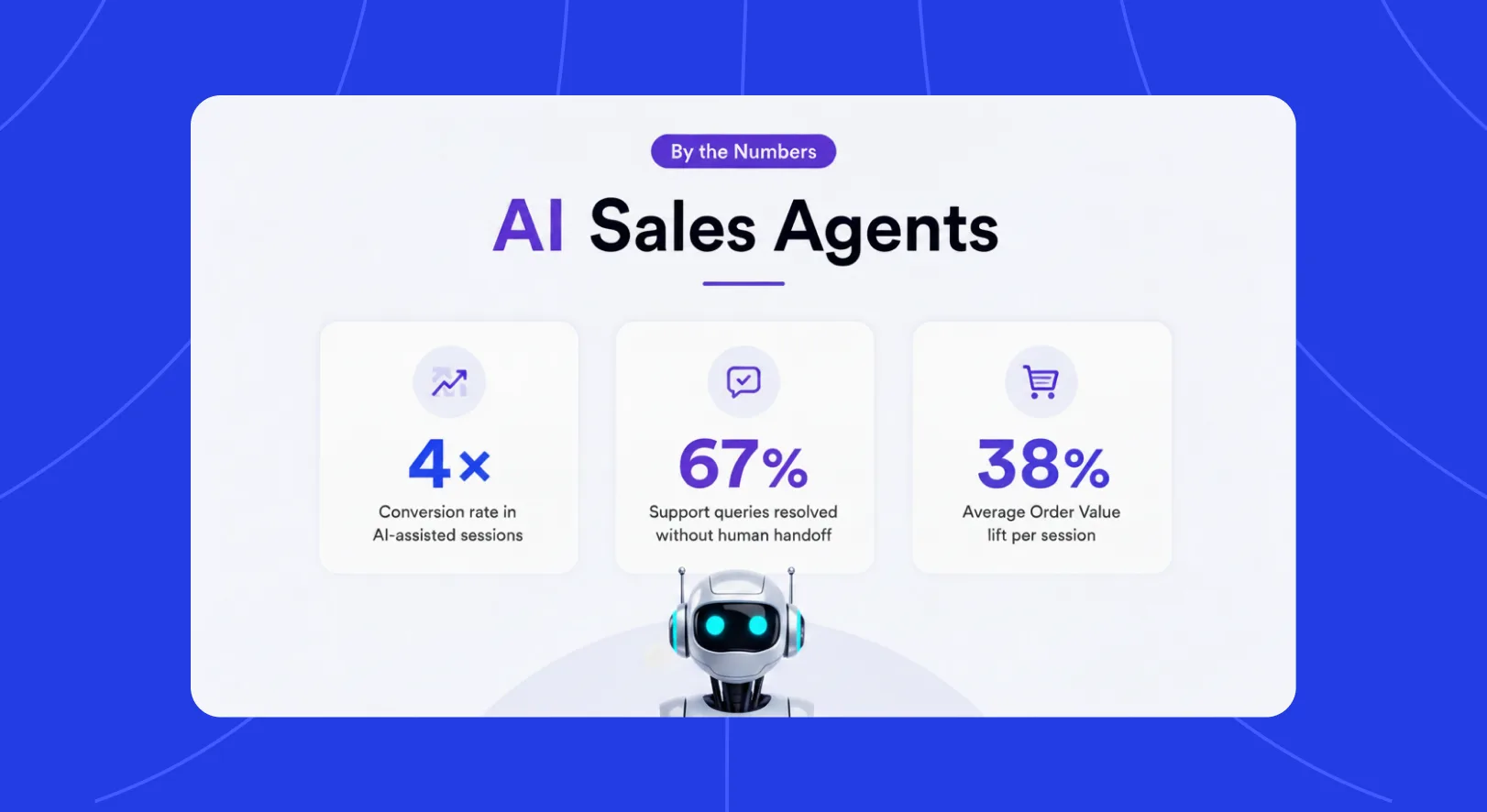
According to a research, AI-assisted shopping sessions convert at 4x the rate of unaided browsing.
AI sales agents can help you with exactly that.
Know the Difference Between an AI Sales Agent and a Chatbot
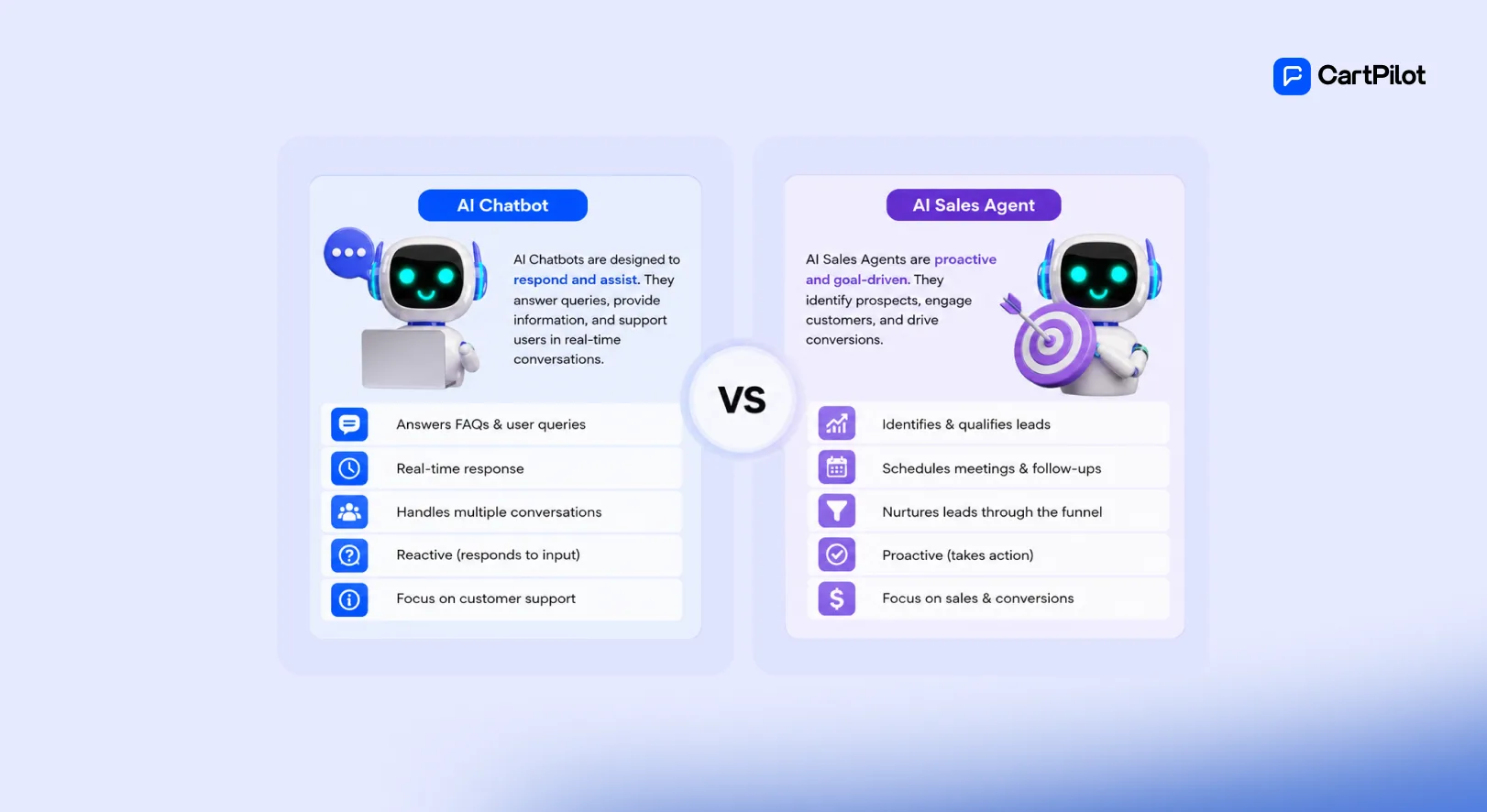
A traditional chatbot gives answers. An AI sales agent takes actions. That one difference changes everything for eCommerce stores.
Traditional chatbots are built around responses. Even the AI-powered ones. They match a question to a scripted answer. They can’t interact with your live store data.
An AI sales agent connects directly to your store. It reads live inventory, pulls order history, and updates the cart. That’s what makes it an agent, not just a bot.
Here’s how the two compare across the things that matter most:
| Capability | Traditional Chatbot | AI Sales Agent |
|---|---|---|
| Understands natural language | Partial (keyword matching) | Full NLP |
| Retrieves live product data | No | Yes |
| Adds items to the cart | No | Yes |
| Tracks customer orders | No | Yes |
| Answers store policy questions | Scripted only | RAG-based |
| Remembers context mid-conversation | No | Yes |
| Requires manual rule-building | Required | Optional |
| Escalates to a human agent | Yes | Yes |
This plays out in a very real way. Ask a chatbot to add something to your cart and you get a product link.
Ask an AI sales agent the same thing and those items show up in your cart.
The line is cart access. A tool that can’t change store data is not an agent. It’s a search engine you can talk to.
Before you buy anything, ask one question: can this tool take actions inside my store? Or does it just give answers?
Resolution quality is different too. Fin AI Agent by Intercom reports a 0.01% hallucination rate in eCommerce contexts. That comes from pulling verified store data, not general AI outputs. Chatbots trained on static content can’t come close.
Now let’s look at what a real AI sales agent can do across the shopping journey.
What an AI Sales Agent Can Do for Your Store
A real AI sales agent covers the full shopping journey. From finding a product to tracking an order after purchase. It handles the tasks customers ask about every single day, without needing a human each time.
Here are the six core things it does:
1. Natural language product search
Shoppers rarely use exact keywords. An AI sales agent reads intent. A shopper who asks for something waterproof for camping under $100 gets matching results from your live catalog. No exact keyword needed.
2. Side-by-side product comparison
When a shopper is stuck between two products, the agent pulls specs, prices, and availability for both. It shows them side by side. Less back-and-forth means fewer abandoned sessions.
3. Autonomous cart management
The agent adds items to the cart, removes them, or updates quantities. Right from the chat window. No redirects. This is what separates AI sales agents from every other chat tool out there.
4. Order tracking
For logged-in customers, the agent pulls real-time order status, delivery estimates, and tracking info. Post-purchase order inquiries make up an estimated 30-40% of total support volume for a typical eCommerce store. Handling this one task automatically makes a real dent in support overhead.
5. Store policy Q&A
Shoppers ask about returns, shipping, and warranties all the time. A trained AI sales agent answers from your actual policy documents using RAG. No manual scripts needed. The answers stay accurate as your policies change.
6. Support offload
The agent handles high-volume, low-effort questions at scale. Size guides, stock availability, coupon eligibility, product materials. Your support team can focus on the things that actually need a human.
AI sales agents are best at product discovery, comparisons, policy questions, and routine tasks. Complex complaints and custom orders still need a real person. A good agent knows when to hand things off.
These six things work together. A shopper who finds the right product fast, compares it, and adds it to the cart in one conversation is much less likely to leave.
How AI Sales Agents Benefit eCommerce Stores
AI sales agents help your store in three major ways: conversion rate, average order value, and support costs. Numbers vary by platform and how well you train the agent. But even the low end of the range is worth paying attention to.
A 4x rate in AI-assisted sessions means shoppers who get help from an agent buy at a much higher rate than those who browse alone. They’re already interested. The agent just shows up at the right moment.
The AOV lift tells its own story. Alhena AI reported a 38% jump in average order value with AI-assisted sessions. That’s what happens when guided selling works. The agent points shoppers to the right product, not just the cheapest one. And shoppers who buy the right thing return it less often.
Returns cost real money. In apparel, processing a single return costs between $150 and $300 per unit. Good guided selling helps shoppers get it right the first time. That saving won’t show up in your conversion report. But it will show up on your P&L.
Support numbers are the most consistent finding across platforms. Autonomous resolution rates of 50-95% are reported across Gorgias, Fin AI, and Rep AI. The spread is wide for a reason. A well-trained agent with a good knowledge base hits the high end. A thin or poorly configured agent lands lower.
Training quality determines where you land in that range. The data is solid. But the agent is only as good as the information it works from.
The numbers explain why adoption is growing fast.
So how do you pick the right tool for the job?
Choosing the Right AI Sales Agent for Your Store
Not every AI sales agent delivers these results. Five things separate the tools worth testing from those that aren’t worth your time.
1. Native platform integration
The agent needs live data from your store. That means your catalog, inventory, orders, and policies. A tool that depends on manual exports or slow syncs is always working with old information. Ask vendors directly: how does your tool connect to my store? What is the sync timeline?
2. Cart manipulation capability
This is the defining line. If the tool can’t add items to your cart from the chat, it’s not a sales agent. No matter what the marketing says. Check this with a live demo. Don’t take their word for it.
3. RAG-based knowledge retrieval
Scripted chatbots use manually written answer banks. When your catalog changes, someone has to update the scripts. A RAG-based agent pulls answers from your actual store documents in real time. Policy pages, product descriptions, FAQs. It stays accurate without constant upkeep. Ask vendors: is your knowledge layer scripted or retrieval-based?
4. Setup time and technical requirements
A tool that needs a developer to go live adds weeks to your timeline and ongoing maintenance costs. Look for something with a setup time under 30 minutes and a no-code config interface. Quick setup is also a sign the product was built for store owners, not engineers.
5. Analytics and feedback visibility
You need to know what the agent is doing. Conversation logs, resolution rates, cart action counts, most-searched products, and where it fails or escalates. Without this data, you can’t get better. If a vendor doesn’t show you the numbers, walk away.
With these five criteria in mind, evaluating any tool becomes much easier. Now let’s look at what’s actually available for WooCommerce stores.
Find an AI Sales Agent That Works with WooCommerce
WooCommerce store owners have fewer options than Shopify merchants. Most tools that support WooCommerce can’t touch the cart. Others need a developer just to get started.
According to BuiltWith, WooCommerce powers 6.6 million active online stores globally. That makes it the most widely installed eCommerce platform in the world. Yet most AI sales agent platforms are built for Shopify first.
The adoption of agentic AI for sales on WooCommerce is still early. That means less competition for the merchants who move first.
Right now, WooCommerce merchants are stuck with two types of options. Chatbots with limited integration and no cart access. Enterprise platforms priced for big retailers.
Here’s how the main tools stack up:
| Tool | WooCommerce Native | Cart Manipulation | Key Limitation |
|---|---|---|---|
| Rep AI | No | Yes | Not available on WooCommerce |
| Tidio | Partial | No | Cannot modify the cart |
| WSChat | Yes | No | No semantic search or AI product understanding |
| Chatbase | Via API only | No | Generic builder, not commerce-native |
| CartPilot | Yes | Yes | None |
The gap is obvious. Rep AI has real cart manipulation. But it only runs on Shopify. WooCommerce merchants have had no real equivalent until recently.
CartPilot is built specifically for this space. It’s WooCommerce-native and adds items to the customer’s cart right from the chat window.
Try CartPilot for Free
Get Started with Your AI Sales Agent in 5 Steps
Setting up an AI sales agent takes less time than most store owners think. The tech side is simple. What really determines how well it works is the quality of information you feed it.
Here are five steps to follow:
Step 1: Audit your support inbox
Pull your last 30 days of support tickets. Find the 10-15 questions that come up most often. Sizing, returns, shipping times, product compatibility. These are the foundation of your agent’s training. Build around what shoppers actually ask.
Step 2: Prepare your knowledge base
Gather your return policy, shipping terms, warranty docs, and product FAQs. Upload them as PDFs or plain text files. Clean, organized inputs lead to accurate answers. A messy or thin knowledge base is the top reason agents underperform in month one.
Step 3: Configure and test your agent
Connect the agent to your store. Set a name, a greeting, and a tone that fits your brand. Then run 20-30 test conversations. Try product searches, comparison requests, policy questions, and edge cases like out-of-stock items. Fix what’s broken before you go live.
Step 4: Set your escalation rules
Decide what always goes to a real person. Payment disputes, upset customers, custom orders, anything outside the agent’s scope. Set these as hard triggers in your config. A smooth handoff with the full chat history beats a failed resolution every time.
Step 5: Track, measure, and improve
For the first 30 days, watch five things: resolution rate, cart action rate, escalation rate, conversation-to-purchase rate, and average session length. Find where conversations end without a resolution. Update your knowledge base based on what you learn. Most agents get a lot better in month one.
The setup is just the beginning. Your agent gets better as your knowledge base grows and you tune it based on real conversations.
Get Answers to Common Questions
What is an AI sales agent?
An AI sales agent is agentic system that connects to your store, understands customer questions, and helps shoppers take action. It can search products, compare items, answer store questions, and add products to the cart without a human agent.
How is an AI sales agent different from a chatbot?
A chatbot mainly answers questions. An AI sales agent can take action inside your store. It can use live product data, check inventory, compare products, track orders, and manage the cart from the chat window.
Can an AI sales agent add items to the cart?
Yes, if the tool supports cart access. This is one of the main features that separates a real AI sales agent from a basic chatbot. If a tool cannot add, remove, or update cart items, it is more like a conversational search tool than a sales agent.
Does an AI sales agent work with WooCommerce?
Yes, but support depends on the tool. Some AI sales agents are built mainly for Shopify. WooCommerce stores should look for a native integration that can read live product data, access cart state, and sync with store orders.
What can an AI sales agent do for an eCommerce store?
An AI sales agent can help shoppers find products, compare options, answer policy questions, check order status, manage carts, and handle common support questions. It works best for product discovery, routine support, and guided selling.
How do I choose the right AI sales agent?
Look for native store integration, cart manipulation, live product data, RAG-based knowledge retrieval, analytics, and simple setup. The most important test is whether the tool can take real actions inside your store, not just answer questions.
How do you train an AI sales agent?
Start by syncing your product catalog and uploading key store documents, such as return policies, shipping terms, warranty details, and FAQs. Then test real customer questions and improve the knowledge base based on conversation logs.
Make the Right Call for Your Store
AI sales agents change how online stores work. The difference isn’t in how they talk to customers. It’s in what they do. A tool that knows your catalog, pulls live store data, and adds to the cart from a conversation is not a support layer. It’s part of your sales team.
The numbers back this up. Higher conversion rates. Better average order value. Real cuts in support costs. The criteria for picking the right tool are clear. And the setup is simpler than most store owners think.
Running a WooCommerce store? CartPilot is built for exactly this. Native cart manipulation, setup in under 10 minutes.
The store that makes buying easy will always outperform the one that makes shoppers figure it out alone.
Category:
Tags: