By Shakhawat Ullah
15 Min Read
BOGO vs Discount Coupons in WooCommerce: Which Drives More Sales?
Here’s a math problem that should settle every WooCommerce promo debate.
Buy One Get One Free and 50% Off give your customer the exact same price per unit. Run it: buy two items under a BOGO deal, and each one costs 50 cents on the dollar. Apply a flat 50% discount, same result. Identical math.
So why does picking the wrong one cost you? Because your customers are not accountants. They see the word free and temporarily forget how money works.
WooCommerce store owners run both promos constantly, often by gut feeling. The problem: one builds buying momentum, while the other slowly trains your best customers to wait for your next sale before buying anything at full price.
In this guide, you’ll learn:
- Why free triggers a completely different response than a percentage off
- When percentage discounts are actually the smarter call
- How each promo type affects your average order value and margins
- Why running too many discount coupons can quietly damage long-term sales
- How to match the right promotion to the right moment
Let’s get into it.
BOGO vs Discount Coupons in WooCommerce: The Quick Answer
BOGO drives more purchases than an equivalent percentage discount in most consumer retail scenarios.
A study from the University of Minnesota’s Carlson School of Management found that BOGO promotions generated 73% more purchases than mathematically identical percentage-off discounts, even when the actual value delivered to the customer was the same.
That said, BOGO is not the right tool for every store or every product.
Percentage discounts outperform when you’re selling high-ticket items, targeting professional or B2B buyers, or running tiered wholesale pricing where your customer needs to calculate their own margin rather than chase a free item.
BOGO is a psychological trigger. A percentage discount is a pricing adjustment.
They work differently because they activate different parts of your customer’s decision-making process. One activates a sense of gain. The other activates a desire to spend less. Those are not the same feeling, and they don’t produce the same behavior.
| BOGO | Percentage Discount | |
|---|---|---|
| Psychological trigger | Gain (receiving something free) | Loss avoidance (paying less) |
| Minimum units moved per order | 2 | 1 |
| Average order value impact | Higher | Variable |
| Margin control | Controlled (one unit stays full price) | Direct reduction per unit |
| Brand perception over time | Generally preserved | Can erode with overuse |
| WooCommerce native support | Limited | Yes, built-in coupon system |
| Best suited for | Consumer goods, clearance, trial offers | Premium products, B2B, bulk pricing |
Most WooCommerce stores selling everyday consumer products will see better results from BOGO.
Stores selling premium or professional items to informed buyers will find percentage discounts more effective. Everything that follows explains exactly why, and gives you a framework for making the right call every time.
What Is BOGO in WooCommerce
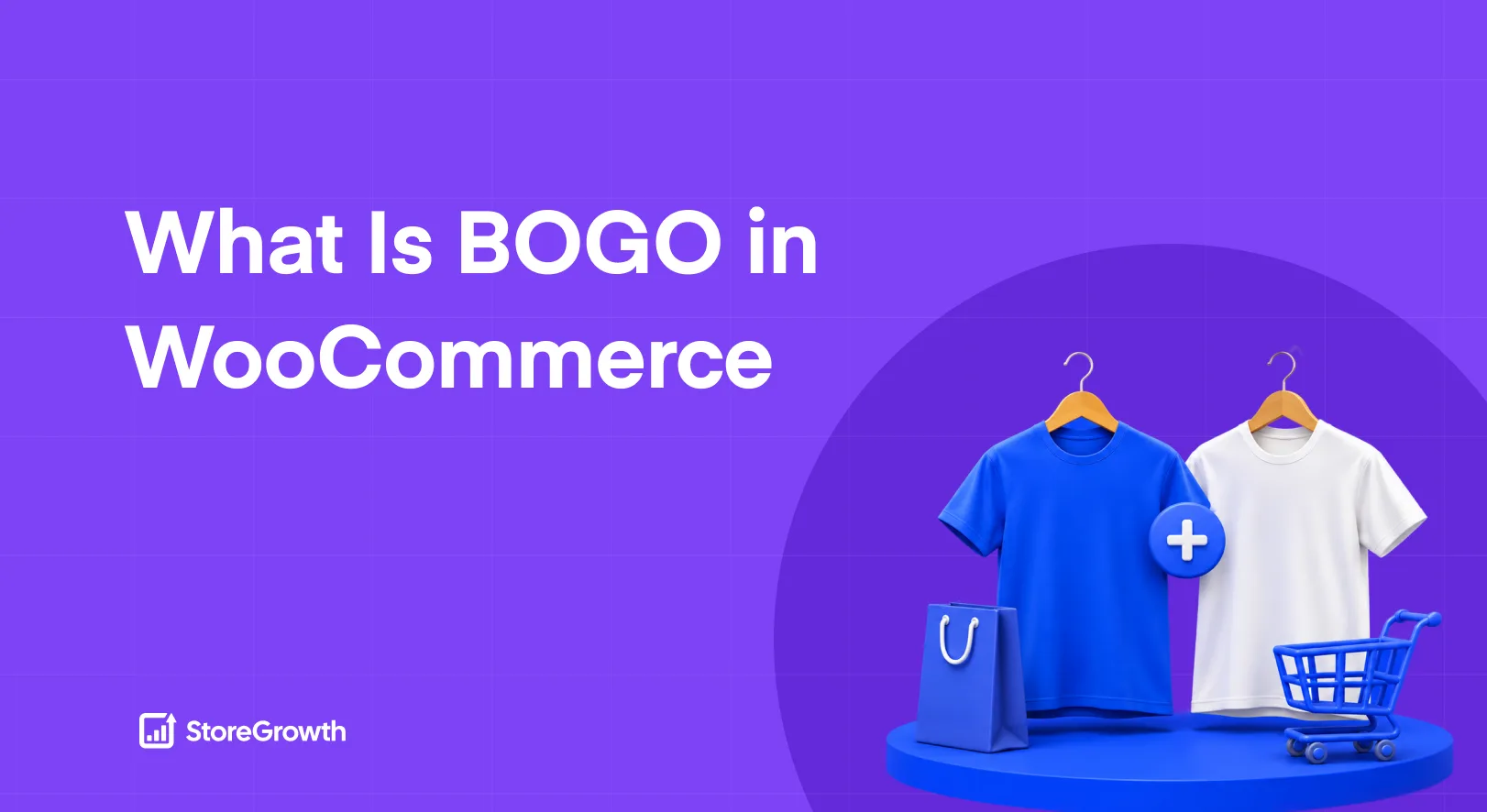
BOGO stands for Buy One Get One, and in WooCommerce it refers to any promotion where purchasing a qualifying item automatically unlocks a second item for free or at a reduced price.
The four most common BOGO structures used in WooCommerce stores:
- Buy One Get One Free: Same product, one unit free. Works well for consumables, apparel basics, and seasonal clearance.
- Buy X Get Y: A different product unlocked by a trigger purchase. Effective for cross-selling complementary items (a yoga mat triggering a free resistance band, for example).
- Buy 2 Get 1 Free: Moves three units per transaction. Works for FMCG, supplements, and stocking-up behavior.
- Spend X Get a Free Gift: A minimum cart value triggers a bonus item. Protects margins by gating the free item behind a spend threshold.
Now, the question might arise, can WooCommerce run BOGO natively? Technically yes, but with significant limitations.
WooCommerce’s built-in coupon system handles fixed discounts and percentages well, but it does not support true BOGO logic out of the box.
Running a Buy One Get One Free deal where the second item is automatically added and zeroed out in the cart requires a dedicated plugin or discount rule engine.
One distinction worth noting before we go deeper: BOGO and coupon-based discounts solve different problems.
Coupons are typically reactive – sent to recover an abandoned cart, reward a loyal customer, or convert a hesitant subscriber. BOGO promotions are typically proactive – displayed sitewide or on a product page to move volume and raise order size. That difference matters when you plan a campaign.
For store owners who want a step-by-step walkthrough of setting up BOGO deals in WooCommerce, StoreGrowth’s WooCommerce BOGO deal guide covers the practical options clearly.
The Psychology of Free
The word free bypasses rational price comparison and triggers a fundamentally different emotional response than a percentage off does.
This is called the Zero Price Effect, and it was documented in a landmark 2007 study published in Marketing Science by researchers Shampanier, Mazar, and Ariely at MIT.
In the study, participants chose between a Lindt Truffle at 14 cents and a Hershey’s Kiss at 1 cent. Most chose the truffle, better value for a small price difference.
When researchers dropped both prices by just 1 cent (making the Kiss free and the Lindt 13 cents), preference dramatically reversed. The majority chose the Hershey’s Kiss, not because it was better, but because free removed all psychological cost from the decision.
This is not irrational behavior. It is a predictable feature of human decision-making. When a price reaches zero, the perceived risk disappears entirely. There is nothing to lose, so there is no reason to hesitate.
In a WooCommerce context, this plays out in measurable ways. When presented with a BOGO versus a mathematically equivalent percentage-off deal, three times as many consumers selected the BOGO option.
No percentage discount consistently produces that level of urgency. The difference is not the value on offer. It is the framing around it.
For WooCommerce store owners, this has a direct implication: the way you frame your promotion changes its impact as much as the promotion itself.
A 50% off banner and a BOGO banner can offer identical value, but one of them will pull significantly more clicks — and consistently move more units per order.
If your current promotions lean heavily on percentage discounts, StoreGrowth’s proven ways to increase WooCommerce sales show how promotional framing fits into a broader conversion strategy.
When Percentage Discounts Actually Win
Percentage discounts outperform BOGO in three specific situations: high-consideration purchases, professional buying, and cart recovery campaigns.
For high-ticket products, the BOGO framing often backfires. A customer shopping for a $1,500 standing desk is running a rational cost-benefit analysis. A 10% discount translates to $150 off – a concrete, calculable saving that feels earned.
Offering a free second desk makes no sense for the product, and a free accessory at that price point feels underwhelming rather than generous. The higher the price and the longer the consideration window, the more effective a clear percentage discount becomes.
B2B and wholesale buyers are another category where percentages consistently win.
Procurement managers and resellers need to calculate their own margins instantly. Tiered percentage pricing (10% off for 10 units, 18% off for 50 units) lets them do that math in seconds. A BOGO offer on a bulk order creates inventory calculation problems and is almost never used in professional purchasing contexts.
Cart abandonment is the third scenario. In a cart recovery email sent 30 minutes after a customer leaves your store, a personalized percentage off code (something like 12% off, framed as exclusive to them) carries urgency and specificity that a BOGO cannot easily match.
The offer feels like a handshake, not a sitewide sale. If cart abandonment is already a problem for your store, our blog on WooCommerce cart abandonment tactics cover the full recovery playbook.
One important caveat: in consumer preference surveys, 67% of shoppers say they prefer percentage-off coupons versus 61% who prefer BOGO deals, according to DemandSage research from 2026.
But preference surveys measure what people say they like, not what actually converts.
In field studies where purchasing behavior is tracked, BOGO consistently pulls ahead. The gap between stated preference and actual behavior is exactly where the Zero Price Effect does its work.
How BOGO and Discounts Affect Your Average Order Value
BOGO raises average order value because every transaction has a built-in minimum: two items. A 50% off coupon applied to a single $20 item yields $10 in revenue. A BOGO on that same $20 item moves two units and yields $20 in revenue. Same discount depth, very different order size.
The margin math is what surprises most store owners when they see it laid out. Take a $30 product with a $10 cost of goods:
| Promotion | Customer Pays | Units Moved | Revenue | COGS | Gross Profit | Gross Margin |
|---|---|---|---|---|---|---|
| 50% Off (1 item) | $15 | 1 | $15 | $10 | $5 | 33% |
| Buy One Get One Free | $30 | 2 | $30 | $20 | $10 | 33% |
| Buy 2 Get 1 Free | $60 | 3 | $60 | $30 | $30 | 50% |
The gross margin percentage on a basic BOGO matches a straight 50% discount exactly. But the BOGO moves twice the inventory and delivers twice the revenue per transaction. The Buy 2 Get 1 Free structure is even more favorable.
The margin percentage actually improves because the customer funds the free item through their own increased spend.
There is a compounding benefit that rarely shows up in the headline numbers: fulfillment. Moving two or three units in one box reduces per-unit shipping costs.
For stores where last-mile delivery is a meaningful line item, this is where BOGO quietly protects more margin than the table above suggests.
There is also a subtler AOV protection that is easy to overlook. A 20% off coupon with no minimum spend can be redeemed on a $5 item, netting almost nothing in revenue after COGS.
BOGO with a qualifying product requirement naturally filters those micro-transactions out. The promotion only fires when the customer has already committed to a meaningful purchase.
For store owners thinking about how product page structure and promotional placement interact with order size, our guide on optimizing WooCommerce product pages covers where BOGO badges, bundle offers, and page layout decisions connect.
How Discounts Train Your Customers to Wait
When a store runs 20% off every other weekend, something predictable happens. Customers stop buying between sales.
This is called discount habituation, and it is one of the more expensive patterns a WooCommerce store can develop without noticing. The customer does not become disloyal. They become strategic. They have learned that your full price is a suggestion and that patience pays off. Every time a sale fires and they buy at a reduced rate, that behavior gets reinforced.
The problem compounds because frequent percentage discounts anchor a new reference price in the customer’s mind.
If your $50 product goes on sale for $40 every month, the $50 price begins to feel like a penalty rather than the default. When you eventually try to hold full price, cart abandonment rises – not because the product got worse, but because the expectation shifted.
Stores that run the same discount promotion more than twice per month on the same products see diminishing returns on each subsequent campaign. The first sale drives genuine lift. The third same-type sale in four weeks mostly captures customers who were going to buy anyway.
BOGO sidesteps this trap more effectively than percentage discounts for one key reason: the primary item stays at full price.
The customer receives a bonus on top of a purchase, not a reduced rate on the product itself. This keeps the price anchor intact. When the BOGO ends, the product still feels worth $50 because it was never marked down to $40. The free item disappeared, not the price.
This matters most for stores with high repeat purchase frequency. If you sell consumables, replenishment products, or anything with a natural reorder cycle, protecting your price anchor is a long-term margin decision, not just a campaign consideration.
Choosing the Right Promotion for Every Scenario
The question is not which promotion type is better in the abstract. It is which one fits the job at hand. Different campaign moments call for different tools.
| Campaign Moment | Best Promotion | Why It Works |
|---|---|---|
| Clearing slow-moving inventory | BOGO or Buy 2 Get 1 Free | Moves volume without signaling desperation; primary price stays intact |
| New product trial | Buy X Get Y (anchor + new product free) | Reduces perceived risk of trying something unfamiliar |
| Holiday or seasonal sale | BOGO (sitewide or category) | Maximizes perceived value in a high-competition window |
| Cart abandonment recovery | Personalized percentage discount | Feels specific to the customer; creates urgency around a paused decision |
| Loyal customer reward | BOGO or free gift with purchase | Frames the offer as a reward, not a price cut |
| B2B or bulk orders | Tiered percentage discount | Lets buyers calculate their own margin; aligns with procurement norms |
| Flash sale | Time-limited percentage off | Speed and simplicity; customers process it instantly without reading terms |
| Cross-sell push | Buy X Get Y (different products) | Drives category exploration without reducing the anchor product value |
The cleanest rule of thumb: use BOGO when your goal is volume, order size, or product trial. Use a percentage discount when your goal is specificity, personalization, or high-ticket conversion.
One pattern that consistently works across campaign types is pairing your promotion with a free shipping threshold.
If customers need to spend $75 to unlock free shipping and your BOGO requires buying two $40 items, you have created natural AOV momentum without stacking incentives awkwardly.
For a broader look at how promotional strategy connects to overall store performance, our WooCommerce sales guide is worth reading before you plan your next campaign.
Frequently Asked Questions
What is the difference between BOGO and a discount coupon in WooCommerce?
BOGO (Buy One Get One) is a promotional structure where purchasing a qualifying item unlocks a second item for free or at a reduced price. A discount coupon applies a percentage or fixed reduction to a product or cart total. Both can deliver identical per-unit value mathematically, but BOGO activates the Zero Price Effect, which often drives stronger purchase behavior because the word “free” changes how customers evaluate value.
Can WooCommerce do BOGO sales natively?
WooCommerce supports percentage and fixed-cart discounts natively, but it does not support true Buy One Get One logic out of the box. Running a BOGO campaign where the free item is automatically added and discounted requires a dedicated discount rules plugin or extension with conditional cart logic.
How do I set up a BOGO sale in WooCommerce?
Install a WooCommerce plugin that supports Buy X Get Y rules. Create a condition that triggers when a qualifying product enters the cart, define the reward item, then apply a full or partial discount to the bonus product. The rule activates automatically when customers meet the requirements.
Is BOGO better than 50% off for increasing WooCommerce sales?
For many consumer retail scenarios, yes. BOGO promotions frequently outperform mathematically equivalent percentage discounts because customers respond differently to receiving something free versus paying less. BOGO also naturally increases units per transaction, helping raise average order value.
How do I create a BOGO coupon in WooCommerce?
WooCommerce does not provide native BOGO coupon functionality. Instead of traditional coupon codes, most stores use discount rule plugins that automatically trigger Buy X Get Y offers when cart conditions are met. Automatic promotions reduce friction and often improve redemption rates.
Does WooCommerce support dynamic pricing and BOGO?
WooCommerce supports advanced pricing models through third-party extensions. Dynamic pricing rules can adjust discounts based on cart quantity, purchase history, customer role, or spending thresholds. BOGO promotions are one form of dynamic pricing logic.
When should I use percentage discounts instead of BOGO?
Percentage discounts work better for high-ticket purchases, B2B sales, wholesale pricing, and cart recovery campaigns where customers need clear savings calculations. BOGO generally performs better when the goal is increasing order size, moving inventory, or encouraging product trials.
Wrapping Up
BOGO and discount coupons are not interchangeable tools. BOGO wins on conversion psychology, average order value, and inventory movement in most consumer retail scenarios. Percentage discounts win on high-ticket items, professional buyers, and cart recovery campaigns.
Run percentage discounts too often and you train your customers to wait. Run BOGO strategically and you move more units, protect your price anchor, and raise the floor on what each order is worth.
The most important thing is matching the promotion to the moment, not defaulting to whichever one feels familiar.
If you’re running a WooCommerce store and want a cleaner way to set up BOGO deals, urgency tools, side carts, and other conversion features from one place, StoreGrowth handles all of it without the plugin stack.
Category:
Tags: